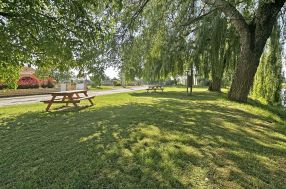
Belleray is a small commune in the Meuse department with 460 inhabitants; it covers 502 hectares and has a population density of 92 inhabitants per km². Its inhabitants are called Bellerois(es); they are affectionately nicknamed "Ducks." The commune lies between the Barrois region to the west and the Meuse hills to the east. It is characterized by a hilly landscape in the west, the highest point of which, located in the Bois de Belleray forest, reaches 257 m, and by a low-lying area in the east that does not exceed 198 m in altitude. The territory is bordered by the Canal de l'Est to the north and by the A1 motorway (Autoroute de l'Est) to the south. Belleray is located 3 km southeast of Verdun, the largest nearby city, on the left bank of the Meuse River. The village has an average altitude of 200 meters and is bordered by the municipalities of Haudainville, Dugny, and Verdun. Its charm lies in its sprawl along the riverbank, creating a pleasant and peaceful setting. This depression corresponds to the alluvial plain of the Meuse River, which crosses the eastern part of the territory and is regularly affected by exceptional floods. The village is situated on a bypass connecting departmental roads 34 and 964. It is relatively unaffected by traffic and benefits from direct access to the Dragon shopping center in Verdun, less than 500 meters away. The municipality comprises a typical Lorraine linear village and a residential area. At one end of the village are the Falouse farm and caves, whose origins date back to the 1914th century. At the other end lies the hamlet of Billemont, a former lime kiln workers' settlement, part of which is now part of the municipality of Belleray. The hamlet was built after the First World War and straddles the territories of the municipalities of Belleray and Dugny.