Destroyed village
de fleury devant douaumont

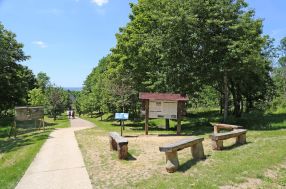
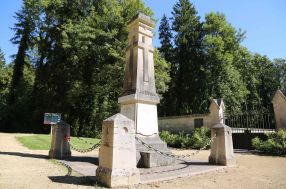
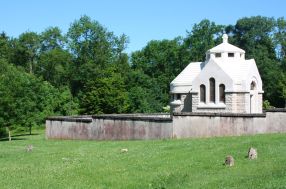
The village of Fleury devant Douaumont, located on wooded heights, often avoided being taken during the invasions that followed the French Revolution of 1789, notably those of 1792, 1814 and 1870. But with the construction of the Séré de Rivières model line of forts on the Meuse coast after the war of 1870-71, its fate would soon turn tragic, because its central location between, in particular, those of Douaumont, Souville, Vaux and the Froideterre fortification would become hardly enviable during the great German offensive of 1916. Initially, however, the construction of the surrounding forts brought it a certain prosperity thanks to a new influx of working and then military population. In 1913, it reached 422 inhabitants, allowing small businesses, inns and artisans to develop their activities alongside those of the traditional rural agricultural world. In September 1914, the Battle of the Marne fixed the Front several kilometers north of Fleury and its inhabitants thought, once again, that they could escape this new German invasion… Indeed, in 1915, it was still completely intact and teeming with combat or logistical troops preparing to go to the front or resting after their relief… On February 21, 1916, as soon as the massive German offensive was launched, the French military authorities ordered the evacuation of the inhabitants towards Bras-sur-Meuse and Verdun. On February 24, 1916, the fall of Fort Douaumont, to the North, and the advance of German troops and their heavy artillery, caused the beginning of the bombardment and the progressive destruction of the village. But it was only after the fall of Fort Vaux, to the east, on June 7, 1916, that the noose tightened rapidly on the village, which from then on found itself on the front line. From that date onwards, the German bombardment became incessant to allow its infantrymen to approach and enter it, for the first time on June 23, 1916. But with fighting raging on both sides, its ruins were retaken the very next day, June 24, by the French soldiers… but this recapture was short-lived… There were a total of 16 changes of possession of the village between June 23 and August 18, 1916, the date of its final recapture by the Moroccan colonial infantry regiment. Among the war events that took place on the soil of the commune, it is worth noting the capture of the Powder Magazine, on July 11, 1916, by the Germans, a shelter under 10 m of rock, where Colonel Coquelin de Lisle, commander of the 255th brigade, died in combat. In October and November 1916, its ruins served as the starting point for offensives led by General Mangin, which made it possible to recapture the Forts of Douaumont and Vaux from the enemy and thus restore relative calm until the end of the war in this village, which had been martyred without interruption for six months. Classified as a "red zone" and declared "Dead for France" in 1918, it benefits from the unique status of a destroyed village in 1919. Unable to rebuild their lives there, its inhabitants erected its chapel-shelter in 1934 on the site of its completely razed church. The building symbolically received the statue of Our Lady of Europe on its facade in 1979 to mark, in particular, the reality of the European Union moving forward in peace. Already, twelve years earlier, on September 17, 1967, the Verdun Memorial was inaugurated, built on the site of the former Fleury station in front of Douaumont at the initiative and in the presence of Mr. Maurice Genevoix, founding president of the National Committee for the Remembrance of Verdun. Through the presence of the Memorial and the numerous memorial projects carried out since then on its territory, the commune of Fleury-devant-Douaumont has legitimately become the most visited destroyed village of all. To see: - The Notre-Dame de l'Europe chapel (fresco of a pieta by Mr. Lantier made in 1934, stained glass windows dedicated to the infantryman, by Gruber in 1934); - The war memorial; - The Verdun Memorial (Museum on the Battle of Verdun) - Paths and markers demarcating the streets and houses of the destroyed village. - Powder Magazine Discovery Trail (remains of the old guard post and vineyard ravine) - 650m botanical trail between the Memorial and the destroyed village.