Destroyed village
of Douaumont

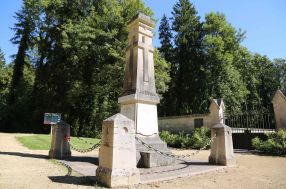
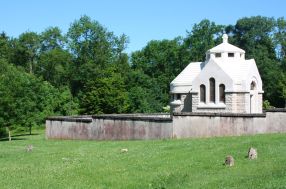
Due to ash dieback (a disease caused by a parasitic and microscopic fungus), some trees and branches in the Forêt d'Exception® of Verdun are weakened and at risk of falling. For security reasons, this site should be avoided. For more information on www.tourisme-verdun.com Created in the Gallo-Roman era, the village of Douaumont, until 1884, experienced a simple and peaceful rural life on its heights overlooking both the Woëvre plain to the East and the Meuse valley to the West. From 1885 onwards, its 192 inhabitants suddenly increased to 576 with the arrival of a large number of earthmoving workers, mainly Italian, in charge of the construction of Fort Douaumont. This influx of people will allow the development of many small businesses which will contribute to a real prosperity for the village. On the eve of the First World War, it still had 288 inhabitants, including many military personnel. During the year 1915, the French General Staff no longer believed in the effectiveness of protecting the Forts in the face of the arrival of new types of munitions such as the torpedo shell which had proven its effectiveness at the beginning of the war against Belgian Forts and decided to partially disarm its Forts including that of Douaumont. During the major German offensive of February 1916, Fort Douaumont remained a serious and symbolic objective for the German general staff, who seized it on February 25 without having to truly fight. Conversely, the village of Douaumont itself suffered a powerful bombardment and deadly assaults from the end of February until March 2, 1916, and fell along with many French soldiers and officers. It was during this battle that Captain Charles de Gaulle, commanding a company of the 33rd Infantry Regiment, was wounded and then taken prisoner in Germany until the end of the war. On March 4, 1916, the entire ruined village of Douaumont, as well as its Fort, fell into the hands of the Germans and were subjected to incessant bombardment by French cannons. The Fort, occupied by many Germans, experienced a violent explosion on May 8, 1916, when a grenade and flamethrower depot was hit by a shell. This explosion killed more than 800 German soldiers. But unable to bury them all near the Fort, the German command decided to wall up 679 bodies in a gallery of the Fort which, even today, remains the only German necropolis on Verdun. On October 24, 1916, the French army, launching a major offensive under the command of General Mangin, managed to recapture the ruins of the village and the Fort thanks to the colonial troops from Morocco engaged in this sector of Douaumont which would remain French until the end of the war. In 1919, Douaumont was among the nine villages destroyed and included in the infamous "red zone" where all reconstruction was prohibited. However, the territory of the commune of Douaumont was chosen to host, between the two wars, not only its war memorial in 1926 and its Saint-Hilaire chapel-shelter, inaugurated in 1932, but above all the great national necropolis, created in 1925 and above which the impressive Douaumont Ossuary was built and inaugurated on September 18, 1927, initiated by Monsignor Ginisty, Bishop of Verdun, who wished to provide a more dignified final resting place for the remains of the soldiers collected on the battlefield of Verdun. Douaumont and its ossuary became an even stronger symbolic place when, on September 22, 1984, Messrs. Kohl and Mitterrand, hand in hand, came to mark, in front of the ossuary, the reality of Franco-German reconciliation. Worth seeing: - The Saint-Hilaire chapel-shelter; - The war memorial;